Festival DoorBackstage: Festival Door
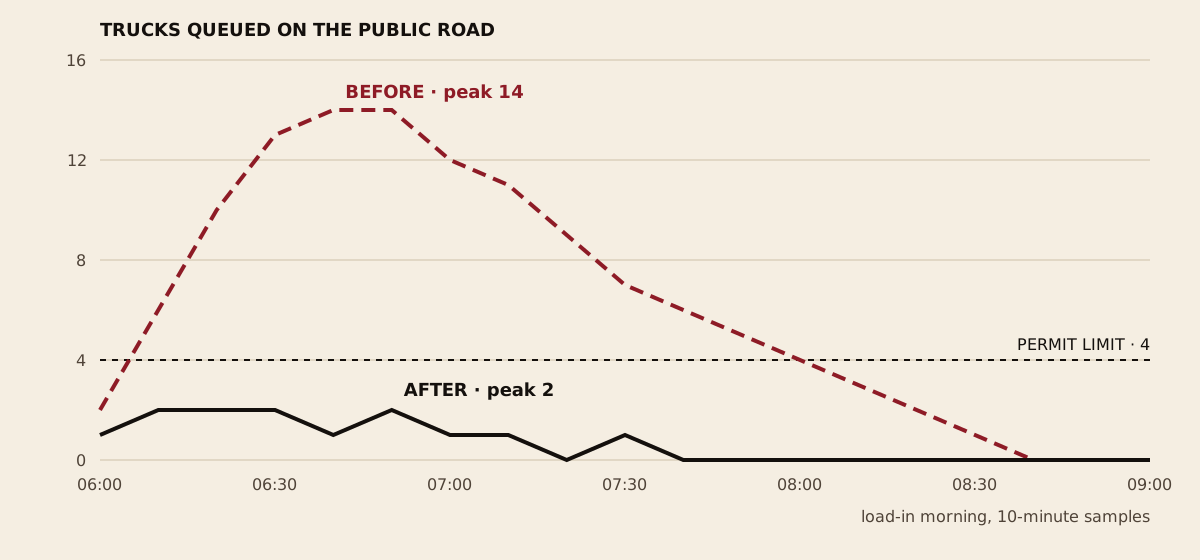
Load-in for 61 trucks cleared in 58 minutes instead of 3 h 05, with no queue on the public road.

The trucks were off the road in under an hour.
Every supplier truck now has a fifteen-minute slot, waits in a holding field off the road, and is scanned once at the gate. The road authority renewed the permit for three years.
58min
Load-in clearing time
Was 3 h 05 the year before.
2
Trucks on the public road at peak
Was 14; the permit allows 4.
6min
Crew gate wait, p90
Was 24 min.
The brief
Zeven Rivieren builds its site in one morning. Suppliers booked arrival times first-come, so almost everyone booked the first hour, and the queue backed up onto the provincial road.
What changed
Slots are allocated by one person and published as a read-only view. Trucks that arrive early wait in a field beside the gate instead of on the road. Backstage: How the gate was rebuilt.
15min
Arrival slot per truck
Was first-come booking for the whole morning.
The festival, the people and every figure on this page are fictional; they demonstrate the theme.
Reconstructed from the radio log, the gate scans and the volunteers’ WhatsApp group.
Backstage updated
Step 1 of 7: Problem. Sixty-one trucks, one road, three hours. Everything arrived at once and queued on a public road.
Weeks 1–2
Every supplier booked the first hour of load-in. The site could take three trucks at a time, so the rest waited on a provincial road with no verge.
- Trucks
- 61
- Arrival window
- 3 h 05
- Trucks queued on public road at peak
- 14
Step 2 of 7: Constraints. What the road authority and the site allowed. Four trucks on the road, three docks, volunteers who arrive at 06:00.
Weeks 2–3
Constraint Limit Type Source Trucks on the public road At most 4 at any time Hard Road permit Loading docks 3 Hard Site plan Volunteers 9, from 06:00 Soft Budget Drivers read the slot email Slots are known in the cab Assumed Unverified Step 3 of 7: Hypotheses. Where the time was going. Arrivals were bunched by the booking process; the docks were idle 41% of the time.
Weeks 3–6
- H1 ✓ Confirmed
Bunching comes from first-come booking, not from traffic.
- Test
- Compare booked times with actual arrivals from last year's gate log.
- Evidence
- 52 of 61 trucks booked the first hour; arrivals matched bookings within 20 minutes.
- H2 ✗ Refuted
The docks are the bottleneck.
- Test
- Time-stamp dock occupancy from last year's photos and radio log.
- Evidence
- Docks were idle 41% of the time; trucks waited for the gate scan, not for a dock.
- H3 ? Inconclusive
Drivers keep their slots once they have them.
- Test
- Compare slot times with gate scans on the day.
- Evidence
- Only one festival of data, and the weather was dry.
Step 4 of 7: Rejected options. Three things I did not build. More docks, a second gate, text-message queue calls.
Week 7
RejectedMore docksThere is no space on the site plan for a fourth dock.
Cost to revisit: High
RejectedA second gateNo power and no road access on the other side of the site.
Cost to revisit: High
RejectedText-message queue callsDrivers do not read messages while driving, and should not.
Cost to revisit: Low
Step 5 of 7: Implementation. Slots, a holding field and one scanner. One allocator, a call-forward field, scan at the gate.
Weeks 8–24
Decision ledger
- One allocator writes slots
- Everyone else reads a published view, so two people never give out the same slot.
- Trucks wait in the holding field
- A field off the road takes the queue out of the permit's count.
- Scan at the gate, not at the dock
- The scan was the slow step, and one scanner at the gate replaces three paper lists.
The published view showed each person only what they needed to act on:
Who Sees Can change Allocator Every slot, every supplier Yes Supplier Their own slot and gate time No Gate volunteer Trucks due in the next 30 minutes No Road marshal Trucks waiting in the holding field No A small script in the slot base stopped the allocator from booking more trucks into one slot than there are docks:
Slot check, run before the view is published
const DOCKS = 3; // site plan const slots = await base.getTable("Slots").selectRecordsAsync(); for (const slot of slots.records) { const trucks = slot.getCellValue("Trucks") ?? []; if (trucks.length > DOCKS) { output.text(`${slot.name}: ${trucks.length} trucks for ${DOCKS} docks`); } }Before
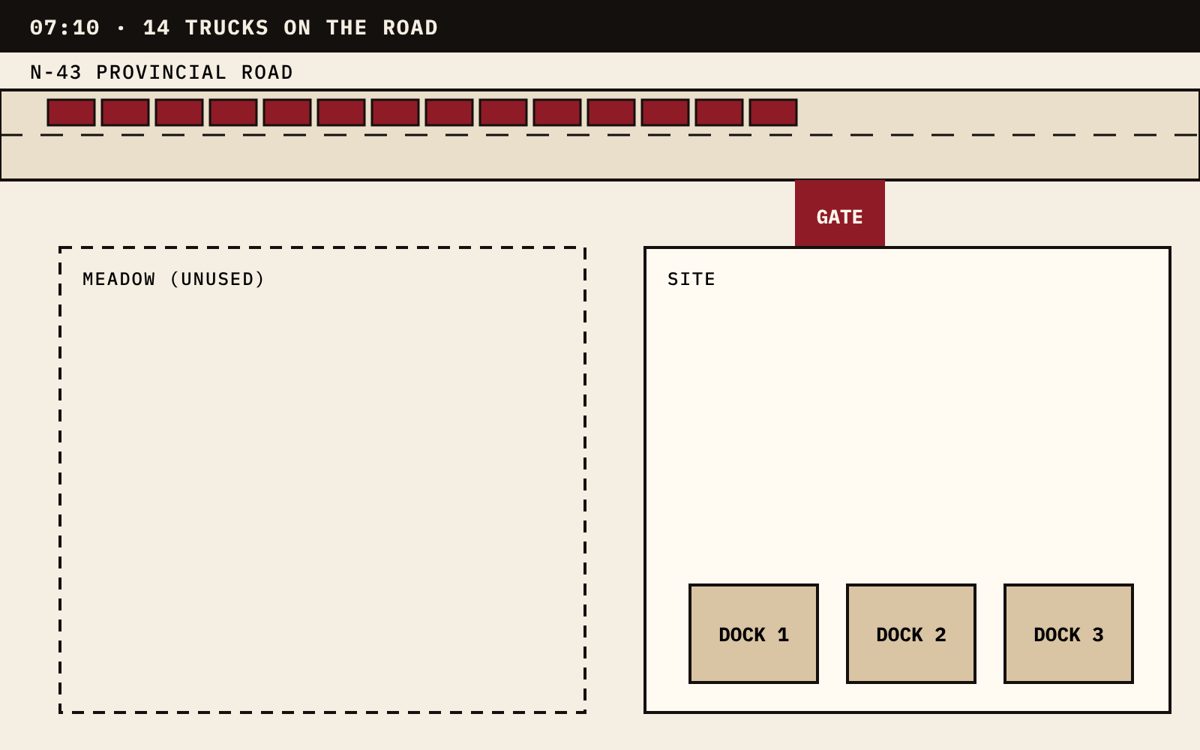
After
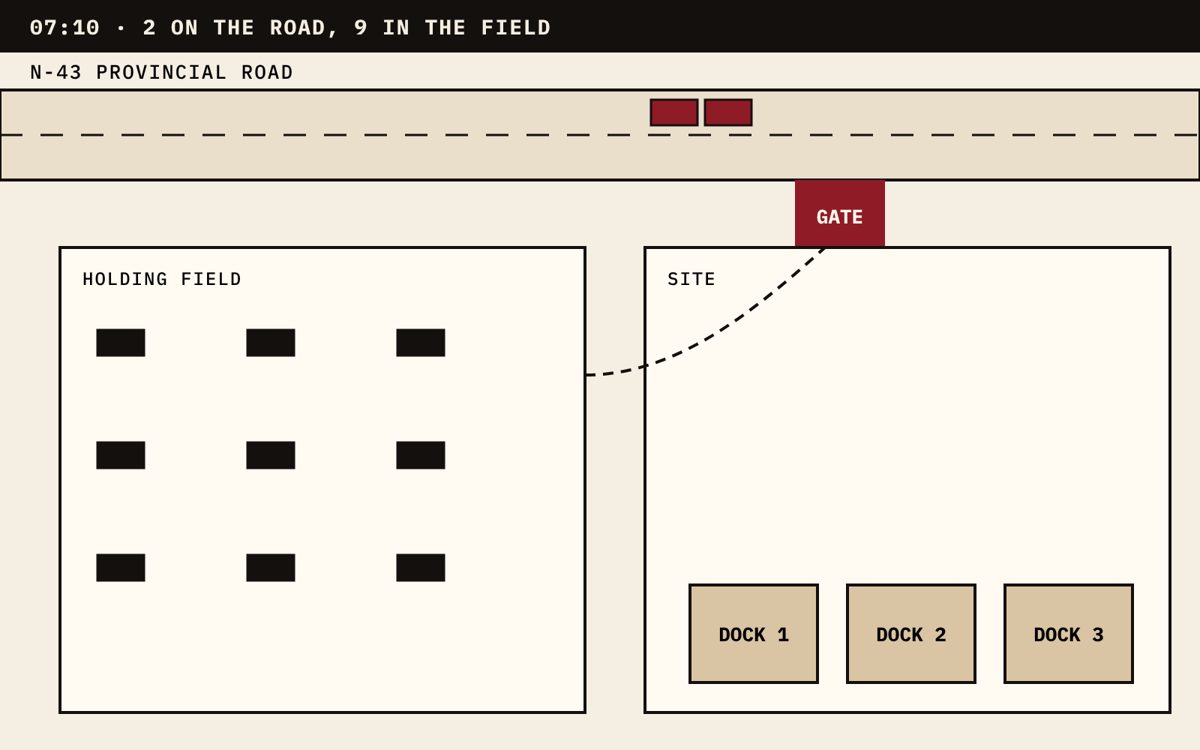
Load-in at 07:10, the same plan in two years. Gate scan per truck: before 1 min 35 s, after 20 s, 79% lower.
Median over all trucks on load-in day. Step 6 of 7: Measured result. What the morning looked like. Load-in cleared in 58 minutes; two trucks on the road at peak.
Week 26
Load-in clearing time: before 3 h 05, after 58 min, 69% lower.
Trucks on the public road at peak: before 14, after 2, 86% lower.
Crew gate wait, p90: before 24 min, after 6 min, 75% lower.
Verdict Moving the wait off the road mattered more than speeding up the docks.
What this does not show: One festival, one site, one weather pattern.
Measured from the gate scanner’s own timestamps and the road marshal’s ten-minute counts.
Step 7 of 7: Note. What I would check next year. H3 is still open: one dry festival says little about slot discipline.
After the debrief
H3 was tested on one festival, and the weather was dry. Before relying on the same plan, I would compare slot times with gate scans over a wet load-in, and ask the marshal to log every truck that arrived more than one slot early.


Want the walkthrough?
Backstage is one toggle away on every case study. If it isn't written up, ask.
hello@prestige-demo.example.org
Booking from March 2027